Core Transit offers a flexible BGP session as an add-on for all of our services, including standard and enterprise. These designs allow you to use Core Transit as a primary service provider or a backup path, while leveraging the automation and operational efficiency of BGP.
Background Knowledge
First, a few things to keep in mind are that a Core Transit service is essentially a virtual circuit between your network and Core Transit over top of another underlying internet service provider. The service carriers IP packets, including your internet traffic, as well as a BGP session when desired. A standard service does this via WireGuard, GRE, or L2TP tunnel. The Enterprise service is even more transparent and hands off a Layer 2 connection that you simply plug into.
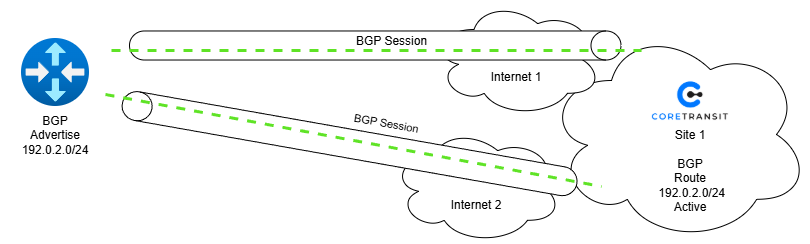
BGP Active / Active – Single POP
In an active/active design, you would leverage two BGP-enabled services from Core Transit to advertise your routes into the global internet routing table. This is nearly identical to how you would configure BGP with two dedicated ISPs, except for Core Transit service delivery versus dedicated fiber delivery. In this example, the services and routes are through the same Core Transit point of presence.
Core Transit Private AS Flexibility
A quick note about customer-provided public IPs and Core Transit private ASN and IP space:
Starting soon, Core Transit will offer private BGP sessions from a single POP to enable failover and automation. This can be done with a Core Transit-provided private AS and with Core Transit IP space smaller than a /24. This will be limited to a single Core Transit POP due to standard internet routing constraints.
Outside of a single POP, typical BGP operation requires a public AS number and /24 or larger IPv4 prefix, as you would expect in global internet routing.
BGP Active / Active Multiple POPs
The same general architecture is available over multiple Core Transit POPs, however, the limitation is that customers must have a public AS and at least a /24 of their own IPv4 space. In this case, Core Transit is a transit provider and the relevant IP routing rules apply.
BGP Active / Failover
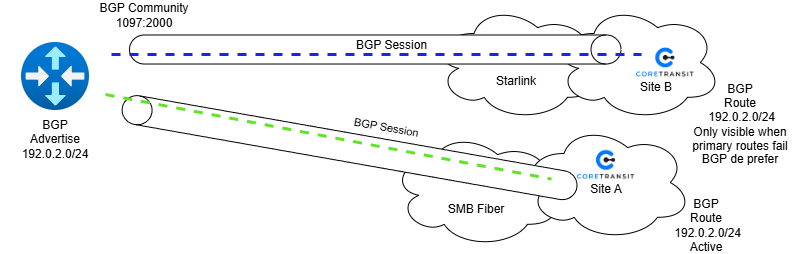
When using Core Transit as a BGP-enabled backup path, the design is similar; however, the failover BGP path will be enabled with the Core Transit failover BGP community. This BGP community lowers the local preference and ups the AS path to ensure the backup path only becomes available when a primary path or primary paths are no longer available. This is a great option when using Starlink or Broadband as a backup to one or more dedicated internet connections. Similarly, if BGP enables a shared fiber link, you could run a BGP primary path over that path and then configure the Starlink path as backup, as pictured below.
Hybrid BGP Designs
Of course, these designs are only suggestions. Core Transit will support alternative designs as well. For instance, two paths to two separate dedicated internet providers can be backed up by a third link, with Core Transit, to be a path of last resort for a dual fiber ISP outage.
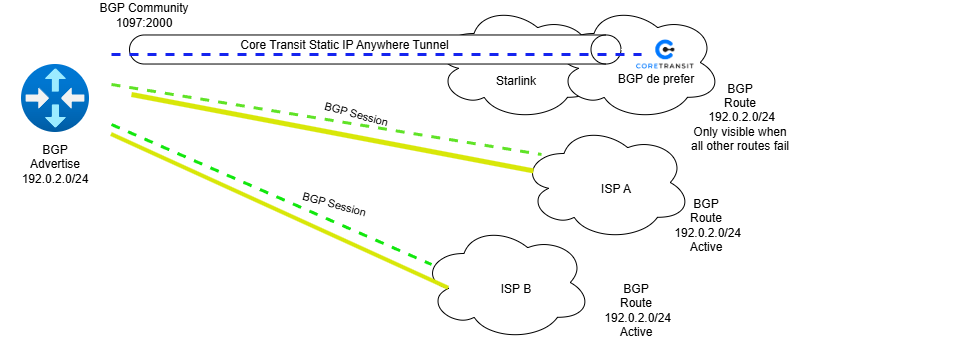
In summary, the BGP capabilities over Core Transit are similar to those of an IP Transit or Dedicated Internet provider, and you can engineer them similarly. Be sure to refer to the BGP configuration notes and the Core Transit knowledge base for more details. Finally, connect with us to get started with a solution today!
Core Transit BGP Design Session
Connect with us to review how a Core Transit BGP design could work for your business!